aritzhaupt.com is the official website for Dr. Albert D. Ritzhaupt, a professor in the College of Education at the University of Florida. All content on this website does not represent the views of the University of Florida, nor the views of any of the organizations in which I am a member. Viewers are welcome to use resources and content from my website so long as proper attribution is provided. Unfortunately, I do not have permission to make all of my research publications available. However, I provide DOIs in each citation for your reference. This website is built using the WordPress content management system and many plugins to enhance your experience. Should you have any questions or concerns, please feel free to contact me.
 Albert D. Ritzhaupt is a Professor of Educational Technology and Computer Science Education, a member of the Institute for Advanced Learning Technologies (IALT), a research member of the Florida Center for Instructional Technology (FCIT), and the President of the International Board of Standards for Training, Performance and Instruction (IBSTPI). Dr. Ritzhaupt previously served as the Program Coordinator for the Computer Science Education program, and the Educational Technology program at the University of Florida. Dr. Ritzhaupt is an accomplished educational researcher and technologist. An award-winning researcher, Dr. Ritzhaupt has published more than 100 journal articles, book chapters, technical reports, and conference proceedings; and has presented his research at numerous state, national, and international conferences. His primary research areas focus on the design, development, utilization, and evaluation of theory-inspired, technology-enhanced learning environments; teaching practices and instructional strategies in computer and information sciences education; operationalizing and measuring technology integration in education, particularly focusing on the factors that facilitate and hinder technology use in formal educational settings; and the professional competencies of individuals in the field of educational technology. Dr. Ritzhaupt was identified as one of the world’s most prolific scholarly authors in the field of educational technology from 2007 to 2017 (Bodily, Leary, & West, 2019). Dr. Ritzhaupt was awarded the 2016 UF Research Foundation Professors distinction, a term-limited professorship awarded to tenured professors who have a distinguished current record of research. In 2019, the Florida Educational Research Association (FERA) selected Dr. Ritzhaupt as the Educational Researcher of the Year.
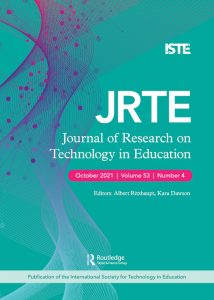
Dr. Ritzhaupt has been funded by the Florida Department of Education (FLDOE), National Institutes of Health (NIH), and National Science Foundation (NSF) to support his research endeavors. His publications have appeared in multiple leading venues, including the Journal of Research on Technology in Education, Educational Technology Research and Development, Journal of Computing in Higher Education, Computers & Education, Journal of Educational Computing Research, and Computers in Human Behavior. Dr. Ritzhaupt has been cited and interviewed in a wide range of news media outlets like Wired, National Public Radio, Chronicles of Higher Education, and Education Week for his research. Dr. Ritzhaupt is Editor-in-Chief of the Journal of Research on Technology in Education (JRTE), the flagship research journal of the International Society for Technology in Education (ISTE); the former Associate Editor of the Journal of Educational Computing Research, a social-science indexed Sage publication; a consulting editor for Educational Technology Research and Development; a member of the scientific board of Computers and Human Behavior; and serves as a reviewer for several other journals. Dr. Ritzhaupt regularly attends and presents at the American Educational Research Association (AERA), ISTE, Florida Educational Research Association (FERA), and the Association for Educational Communications and Technology (AECT). In terms of professional service and leadership, Dr. Ritzhaupt has served as Chair of the Games and Simulations Special Interest Group (SIG) in ISTE, past-Chair of SIG Instructional Technology in AERA, past-President and Director of FERA, and Past-President of the Design and Development Division within AECT. Dr. Ritzhaupt presently serves as the President of the International Board of Standards for Training, Performance and Instruction (IBSTPI). Dr. Ritzhaupt is an active member of the Educational Technology, Computer Science Education, and Educational Research community both locally and nationally.

Inspired by multiple perspectives, Dr. Ritzhaupt employs a variety of instructional methods in his teaching practice and he consistently receives high scores in his teaching by students. Dr. Ritzhaupt teaches a wide range of courses for the University of Florida, including on topics like software design and development for educational purposes, multimedia design and development, educational games and simulations, traditional and agile project management, introductory and advanced instructional design, educational research design and applied statistical methods, and advanced seminar courses for doctoral students in the field of Educational Technology. Previously, Dr. Ritzhaupt taught computer science courses for both community colleges and universities in Florida, particularly in the areas of software design and development. Dr. Ritzhaupt is a Level 2 Google Certified Educator (GCE) and a Microsoft Certified Educator (MCE), and commonly uses emerging technologies in his teaching practice. Dr. Ritzhaupt considers his greatest scholarly contribution to be the more than 30 doctoral students he has mentored to completion in the Educational Technology and Computer Science Education programs.